Beyond the Four Varnas
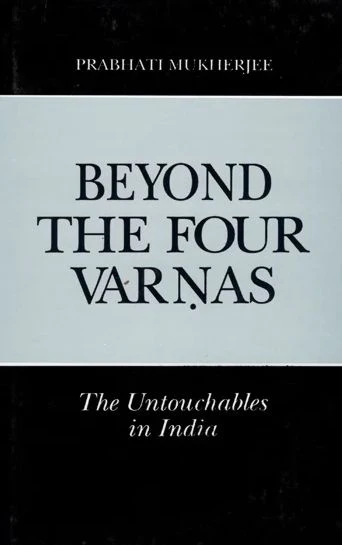
Who were the untouchables in India?' and 'why and when did they become so?' are some of the questions the present study attempts to answer. As the saga proceeds, from the Rgveda onward, it unfolds various facets of the problem faced by these people. The main focus of the study is on the role of the 'Aryans' in India around ca. 400 B.C. to A.D. 200, when significant changes took place in society. From about this time the exact Sanskrit word for 'untouchable' began to appear in the sacred texts, replacing the words like 'impure', 'unclean', etc. This was the first identification of untouchables as a marginal group, living at the mercy of the predominant 'Aryans' and being used as and when necessary. This narrative of emergence of untouchability in India is profusely documented, and substantiates how Indology combined with anthropology and sociology can make a meaningful contribution to understanding social reality.
PRABHATI MUKHERJEE, Research Associate of Fernand Braudel Center, SUNYBinghamton, U.S.A., since 1977, has recently completed her term as a Fellow of the Indian Institute of Advanced Study, Shimla. Tranined by Walter Ruben of Humboldt-University, Berlin, from where she obtained the degree of D.Phil., Dr Mukherjee is mainly concerned with two areas of research in the social history of India from a critical examination of Sanskrit texts; the role of women and stratification in Indian society. Besides a number of papers, she has written a book entitled Hindu Women: Normative Models (1978).
Who were the untouchables in India?' and 'why and when did they become so?' are some of the questions the present study attempts to answer. As the saga proceeds, from the Rgveda onward, it unfolds various facets of the problem faced by these people. The main focus of the study is on the role of the 'Aryans' in India around ca. 400 B.C. to A.D. 200, when significant changes took place in society. From about this time the exact Sanskrit word for 'untouchable' began to appear in the sacred texts, replacing the words like 'impure', 'unclean', etc. This was the first identification of untouchables as a marginal group, living at the mercy of the predominant 'Aryans' and being used as and when necessary. This narrative of emergence of untouchability in India is profusely documented, and substantiates how Indology combined with anthropology and sociology can make a meaningful contribution to understanding social reality.
PRABHATI MUKHERJEE, Research Associate of Fernand Braudel Center, SUNYBinghamton, U.S.A., since 1977, has recently completed her term as a Fellow of the Indian Institute of Advanced Study, Shimla. Tranined by Walter Ruben of Humboldt-University, Berlin, from where she obtained the degree of D.Phil., Dr Mukherjee is mainly concerned with two areas of research in the social history of India from a critical examination of Sanskrit texts; the role of women and stratification in Indian society. Besides a number of papers, she has written a book entitled Hindu Women: Normative Models (1978).
Original: $5.85
-70%$5.85
$1.75Description
Who were the untouchables in India?' and 'why and when did they become so?' are some of the questions the present study attempts to answer. As the saga proceeds, from the Rgveda onward, it unfolds various facets of the problem faced by these people. The main focus of the study is on the role of the 'Aryans' in India around ca. 400 B.C. to A.D. 200, when significant changes took place in society. From about this time the exact Sanskrit word for 'untouchable' began to appear in the sacred texts, replacing the words like 'impure', 'unclean', etc. This was the first identification of untouchables as a marginal group, living at the mercy of the predominant 'Aryans' and being used as and when necessary. This narrative of emergence of untouchability in India is profusely documented, and substantiates how Indology combined with anthropology and sociology can make a meaningful contribution to understanding social reality.
PRABHATI MUKHERJEE, Research Associate of Fernand Braudel Center, SUNYBinghamton, U.S.A., since 1977, has recently completed her term as a Fellow of the Indian Institute of Advanced Study, Shimla. Tranined by Walter Ruben of Humboldt-University, Berlin, from where she obtained the degree of D.Phil., Dr Mukherjee is mainly concerned with two areas of research in the social history of India from a critical examination of Sanskrit texts; the role of women and stratification in Indian society. Besides a number of papers, she has written a book entitled Hindu Women: Normative Models (1978).